
Showing posts with label Filipino. Show all posts

19 December 2008

The Foundry + Sprinkles

Last Sunday was my birthday. Considering I am still recovering from my wedding three weeks earlier (hence this being the first BFT post in 5+ months -- w00t!), I decided on a low-key affair consisting of: sleeping in, coffee infused with a cinnamon stick (inspired by Mexico honeymoon), passively watching football while tooling around on my new MacBook Pro, and finally getting up in the afternoon to hit up two Los Angeles spots I've heard much about.


I first heard of The Foundry from an admissions counselor at Kitchen Academy in Hollywood (I have and still do flirt with enrolling). They offer a fixed menu on Sundays. According to our waiter, Chef Eric Greenspan hits up the local farmer's markets and devises the menu that very day. Which is a bit of a lie since I peeked at the menu on their website on Saturday, and a large majority of it was indeed there on Sunday, but no matter. I really dug the vibe: Low key, sophisticated without being pretentious, with a bar out front that has just enough room to squeeze in jazz and blues acts. Chef Greenspan even came out a couple of times to make sure everyone was enjoying their food. Sure, you will be surrounded by entertainment industry conversations, and the valet is seven freakin' dollars, but the food... oh the food.

Finely crafted. Gorgeous. Flavorful. We stuffed ourselves on four courses.

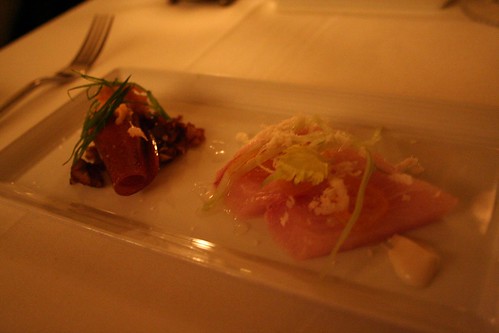
Camille's 1st course -- Duo of raw fish: spicy albacore tartare, chestnut, persimmon / yellowtail sashimi, celery, kumquats

She says: "Fabulous. Phresh with a P-H. I really liked the salt on the yellowtail with the celery and the citrus." Note the tartare rolled up inside a date.
My 1st course -- Potato soup: gruyere and leek bread pudding / bacon / fried egg

They bring out the dish with the bread pudding, bacon, and egg by itself. Then they pour the soup right in front of you. The soup was flavorful without being too heavy. And I'm a big believer in topping anything and everything with a fried egg. When you think about it, it's like a classic diner breakfast in soup form. Except really elegant. The bread putting puts it over the top. Lots of different textures going on.


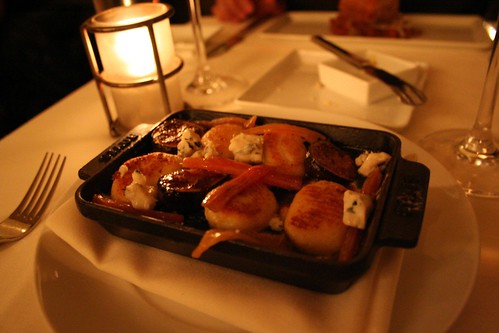
Camille's 2nd course -- Potato Gnocchi: swiss chard / figs / blue cheese

She says: "The best thing there." I had a bite. Twas most cheesy, in a good way.
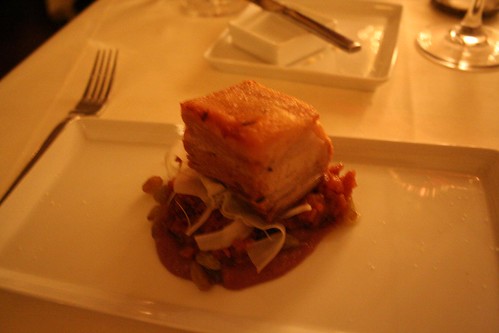
My 2nd course -- Crispy pork belly: yams / fennel / raisins

Somewhat similar to one of my favorite Filipino dishes, lechon kawali. Which is exactly why I ordered it. It didn't disappoint. The pork belly was perfectly cooked, with crispy skin/fat that wasn't oily in the slightest, plus really tender and juicy meat. Camille suspects that, instead of deep frying it, they probably ladled hot oil to crisp it. The salty/crispy of the pork on top of the rich sweetness of the yam was delightful.

Camille's entree -- Crispy skin salmon: broccoli / walnuts / orange

She says: "Cooked perfectly. But it was 'eh.' Something you can get at any restaurant."


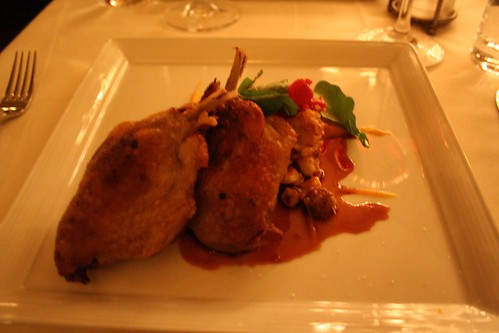
My entree -- Duck confit: squash / piquillo peppers / dried cherry / spaetzle

I was surprised they gave me two duck legs. At this point, after potato soup and pork belly, I was beginning to fill up. Crispy and juicy in all the right spots. I don't know what kind of salt is used, but it brings a subtle yet distinct layer of flavor to the duck. The fixings were fine, but not the melding of flavors that my previous courses had.
Dessert -- Eggnog creme brulee: dried fruits / orange sherbert

At this point we were about to explode. I didn't mention that between each course, a small bread was served. No more than two bites apiece, but we're four courses in, now. Woof. I really liked the addition of the fruit and especially the orange sherbert. The citrus helps cut through the richness and sweetness of the creme brulee. I wanted the sugar coating to have a more distinctive crunch... you know, the whole brulee bit. In fairness, I was done before this thing hit the table. Lots. Of. Food.


We had actually gone to Sprinkles beforehand to pick up cupcakes. You'd have to be a hermit to not have heard of Sprinkles. They were recommended by Martha Stewart at one point, which is basically like having the clouds part and God tell you you are his son. And as evidenced by the "coming soon" part of their site, they are going to be positively everywhere. Cupcakes are the new gourmet frozen yogurt, apparently.

And lo and behold, when we arrived, there was a 20-minute line out front. I am immediately distrustful of famous Los Angeles proprietors who flaunt their fame and have excessive lines (Pink's Hot Dogs can lick my ass), but I was won over by one distinct menu offering on Sprinkles' wall: a shot of frosting. Awesome!

We didn't actually get a shot of frosting, but the cupcakes were good. Firm and moist and sweet and all that stuff. They do a cream cheese frosting that's very nice. The red velvet cupcakes are one of their most popular, and for good reason. Even though I was stuffed, I plowed through one when we'd returned home. Most satisfying.


And to top it all off, they make dog-friendly cupcakes.

06 February 2008

Kare Kare

Get a slow cooker.

If I've learned one thing over the short life of this blog that I can impart, it's that. Get a slow cooker. It's like cooking but... not. For some reason, I used to associate slow cookers with gimmick culinary contraptions like salad shooters, knuckle guards, or the Ronco Food Dehydrator (it makes turkey jerkey!). In fact, it probably does less than all those Magic Bullet-type devices. The only thing it does is slowly but surely heat whatever you put inside it.

But, oh, the magic it did for my latest batch of kare kare.My recent foray into Filipino cooking was inspired by my recent Christmas trip home to the Bay Area. It was the first time I'd ever spent Christmas day without my parents, who flew south for the winter. So, when I wasn't officially upgrading Camille from girlfriend to fiance or playing Guitar Hero, I was watching Camille's mother cook. Because she's the working mother of four kids, she has an amazing shorthand for pinoy dishes that are notoriously laborious. And using only two burners and a turbo cooker, to boot.

I'd previously tried kare kare, the peanut-based oxtail stew, once before using a recipe from Memories of Philippine Kitchens, which has more traditional leanings in terms of flavor and preparation. The recipe calls for an initial stewing to soften the meat and make a broth, cooling overnight to separate the fat for use the next day while cooking an assortment of veggies. It also uses equal portions of peanuts and peanut butter while more contemporary recipes pour on the peanut butter for a richer flavor and texture.

Camille's mom? She cuts onions and minces garlic, tossing them into a hot pot as she goes, then sears off the oxtail, boils it down, dumps a combination of sauce and flavor packets, then the peanut butter, then bok choy and longbeans. Hour and one-half, two hours tops. She has kids, she says.

And it works. It's really good. Sweet and savory, beefy, peanut buttery goodness. The gooey thickness of the peanut butter sauce with balance from the mildly sweet, leafy bok choy and the bite of the green beans. Except the oxtail meat is just a tad too firm. I wanted to do a hybrid of the two methods, but unfortunately there's really no short cut for breaking down beef into a tender, juicy wonder.

Enter the slow cooker.

Ingredients
2 lbs. oxtail, cut into 2-inch pieces
5-6 cloves of garlic, peeled and mashed
2 medium onions, chopped
1 1/2 - 2 cups peanut butter
2 handfuls (about 1 lbs.) longbeans, trimmed and halved
4-5 heads baby bok choy, rinsed
3 tbs. oil
2 eggplants, halved and chopped into 3/4" pieces (optional)
steamed rice

Equipment
slow cooker
large, heavy pot

(I bought a Le Creuset dutch oven a few years back that's big and heavy and beautiful. There are probably cheaper dutch ovens that are reasonably comparable performance-wise, but they ain't as good and they're definitely not as beautiful, and no one brags about their reasonably comparable and ugly dutch oven. My point: go cheap everywhere else, but indulge yourself with at least one Le Creuset.)

My cousin recommended slow cooking overnight, which I did by simply placing the oxtail in, filling the crock pot with water, covering, and setting to low. No need for refrigeration or fat-skimming or any of that. In the morning, the meat was still a touch on the firm side. So, I just left the thing on and went to work.

When I returned home, the oxtail had been slow cooking for about 18 hours, resulting in suitably beefy broth and meat that was fall-off-the-bone tender. Not a figure of speech, it was falling clean off the bone. The fat and cartilage melted away and the meat fiber sloughed off when I tried fishing it out of the crock pot, leaving white, clean bones that looked like a cross between a biplane and an X-Wing fighter. Cool.Set aside the oxtail, heat the oil, and saute the onions and garlic about five minutes. Add the peanut butter and the broth. I used about eight cups of broth, but if it's not enough you can add more later. Let simmer until the peanut butter has incorporated well, then add the oxtail and eggplant. Continue to simmer for about 10 minutes.

Add the longbeans and bok choy and simmer another 10 minutes for the flavors to combine. Taste and adjust the texture to your liking by adding either more broth or more peanut butter.

Portion rice into bowls, then ladle the kare kare into it. Now, all you need is a spoon. Though Camille and I have been on a brown rice kick lately, I found that the dryer, nuttier brown rice wasn't able to soak up the stew as well as white rice.

01 February 2008

Lechon (or, How to Commit Suicide by Deep Frying)

Lechon Kawali

One of the most iconic traditional pinoy dishes is lechon, the spit-roasted pig. Sadly, I have neither a whole pig, large skewer, nor a large fire, not to mention the wherewithal to clean, season, and skewer a whole pig. Which is why I opted for lechon kawali, the indoor version that involves boiling, drying, and deep-frying pork belly.
It's a celebration of fat. Making it helps you realize it's basically a bacon slab deliberately cooked in such a way so the thick layer of fat under the skin doesn't melt away. You want that fat. You need that fat. It's good eating, that fat. Looking at lechon kawali is looking at a chunk of boiled, deep-fried fat that's been seasoned with a touch of meat.

This is atypical Filipino family party food, but my mom never made it at home. And now I know why. My soon-to-be mother-in-law taught me her simplified method that replaces frying with a turbo broiler, but since I don't have a one I had to mix and match various methods.

You will need...

3-4 lbs. pork belly, cut into strips
salt & pepper
cane vinegar (sukang maasim)
a large pot
a lot of piping hot oil for frying
acceptance of your own mortality
a splatter shield
a draining station (paper towels, or a slotted baking sheet set over paper towels, etc.)

Cut the pork belly into long strips, about 1 - 1 1/2" wide. Season with salt and pepper. Boil for about an hour, until the meat is tender and the layer of fat has swollen considerably. Remove the strips and let dry on paper towels for at least one hour.

The proper post-boiling step as taken from the terrific book Memories of Philippine Kitchens...

"3. While simmering the pork, preheat the oven to 400. Using tongs, transfer the pork to a roasting pan fitted with a wire rack, pat the pork dry with paper towels, and brush on both sides with vinegar. Transfer to the oven and roast for 20 to 30 minutes to dry, turning onces with tongs. Remove from oven and keep in a cool place to dry for another 4 hours."

Then fry the pieces about 6-7 minutes until the skin is crispy all the way through. Set aside to drain and cool.

Now, I'm making a point of referencing and quoting because that isn't what I did.

Following the boil, I gave the strips several pat downs, cut them into large chunks, and popped them into the freezer for about ten minutes while I heated the oil. Despite the vast majority of recipes I looked up -- you know, the recipes based on generations of experience -- recommending to dry the pork for a prolonged period, I went with the one recipe that said one hour of air drying would do the trick. Yeah, not so much.

Quick and dirty science lesson if you've never thought about why hot oil goes batshit crazy when water is introduced: water and oil do not mix (clearly I am a genius). When molecules of water are surrounded on all sides by hot oil, the water instantaneously boils. The resulting vapor then goes racing up towards the surface and looks around to see there's a microwave and a floor and my face within reach, and explodes like so much nitroglycerin.

Of course, I knew this and figured all the drying was for this exact reason. But, damnit, I wanted lechon kawali NOW!

Well, it seems pig fat does a reasonable job of holding a lot of water. I'm going to estimate that the top of my microwave is about three and a half feet above the stove. Scorching vegetable oil exploding through a splatter shield and above the microwave might possibly be the scariest thing I've witnessed in person.

Anyway, be sure to fry the pieces until they are crispy and don't give under a little pressure from tongs. Lechon sauce would be nice (like Mang Tomas "All Purpose Sauce"), but Camille simply likes to drizzle some vinegar over it. The crispy, rich fat and the lean meat, combined with the acid saltiness of the vinegar makes for some addicting, life-affirming food.
Paksiw Na Lechon

And it doesn't stop. No, the real beauty of lechon is the leftovers can be cooked into a completely different dish. Most Filipino restaurants are casual turo turo joints, which means "point point." But when I'm in line with my tray, staring down at my choices, I'm always looking for one thing: paksiw na lechon. (As for the Filipino trend of doubling up on words... don't don't ask.)

Using vinegar, soy sauce, brown sugar, and a whole lot of "All Purpose Sauce" to stew the meat and reverse all that drying and deep frying, paksiw na lechon is more hearty and savory. It's absolutely required to have rice on the side to soak up the juices (not that any Filipino would be caught dead eating this without a side of rice). Unlike lechon kawali, the meat takes center stage. The pork flavor really comes to the fore with the sweet and tangy stew, the richness of the fat working more as a balancing counterpoint.

I used a recipe from pinoycook.net which basically calls for letting the meat break down in the stew, then adding All Purpose Sauce (which, by the way, is used for all purposes lechon, but nothing else) to smooth things out. In restaurants, it's usually fairly thick, but this preparation is runnier, more in line with most stews.
Salty, sweet, savory. I love this stuff.

17 January 2008

Bulalo

That's bu-la-LO. Don't worry, the first time I read it, I mispronounced it, too.

I really enjoy the notion that food is true living history, even though 99% of the time it's, you know, dead. The term "comfort food" doesn't quite capture what happens when a dish not only works on your senses and sentiments, but connects you to a culture. Especially when said culture is "your" culture. Nostalgia from childhood is one thing. Realizing that thousands of people for centuries have eaten what you're eating is oddly transcendent.

I'm a first generation Filipino-American. I don't speak Tagalog. I despise pinoy movies. Some of the food even scares me. At least, it used to. My mom didn't make too many Filipino dishes while I was growing up, but one staple she always fell back on is bulalo. I did reference a recipe when I made it recently, but I mainly went along with my mom's beautifully simple directions. Beef shank. Bones. Water. Cook it.

It's about two parts water to one part beef material, then reduce it down and taste as you go. Whole peppercorns and sliced onions add a nice layer of flavor, but really all you're making is beef broth that's savory and rich from the bone marrow and melted fat. While it's probably a good idea to skim some of the fat, that's precisely what makes bulalo into lip-smackingly good stuff. Toss in some cabbage and potatoes to go along with the tender, stewed beef, and then ladle the stuff over rice, and you've got a cheap meal fit for fine, upstanding immigrants. Suddenly, I was ten again.
I specifically remember my dad spooning and eventually sucking the marrow out of the bone. This always freaked me out to no end, but now I know better. The bone marrow is by far the best part of the dish. It's where the flavor in the broth comes from. Camille and I tried foie gras recently, the fattened goose liver that's always prevalent in the menus on Top Chef. It's creamy and rich, well deserving of it's reputation.

Stewed beef marrow is kinda like that. Concentrated, decadent, fatty beef flavor. Not quite as creamy, but just as guilt-inducingly good. I don't know what kind of fat and cholesterol takes to my veins after eating this dish. I don't want to know. All I wanted to think about after scraping the last vestiges of marrow from the bone was more efficient ways to get it out from inside the hollow. If you handed me a stewed bone and a wide straw, I'd totally go for it.