 I wonder if the found footage/shaky cam sub-genre of film will branch out from witches and monsters to include an actual domestic-themed "home" movie. But then I suppose no one would care to watch meandering stories of dysfunctional families. Oh wait, Little Miss Sunshine happened.
Anyway, 1-18-08 has finally delivered the film initially code named "Cloverfield" and shot under the names "Slusho" and "Cheese," and finally released as... Cloverfield. It follows through on the cryptic, gripping teaser trailer that promised a disaster/monster movie told from the point of view of the man (or Abercrombie & Fitch model) on the street.
It reinvents the genre in such a simple way that the film has an immediacy lacking in the likes of bloated behemoths like Godzilla (1998) or even the big event movie that carried Cloverfield's teaser trailer, Transformers. All the cheesy artifice that plagues these movies -- the military officers and government officials with their needless explanations, the interminable "something strange is going on" sequences followed by the "this can't be happening!" sequences -- all of that melts away. If you're someone who demands to know what this monster is and where it came from, you're going to be disappointed. This is a monster movie boiled down to the essence of what we all truly want: people running from something scary. It's surprising how spine-tingling the appearance of stealth bombers and machine guns can be when their arrival is a signal of danger, and not a precursor to more needless plot.
However, one thing Cloverfield doesn't reinvent is melodrama. Fans of JJ Abrams and his gang from their work on Alias and Lost will know they have a deft way with banter and group dynamics. Their characters are always endearing even if they're not terribly interesting (save for the notoriously inane Nikki and Paulo from Lost). The film takes a healthy amount of time to set up Rob, a young man who's childhood friendship with Beth has finally turned into romance on the eve of his career taking off. Unfortunately, the characters that end up together for the majority of the film are a hodgepodge bunch. While I applaud the filmmakers' willingness to kill characters, we end up with a group that lacks much chemistry.
What I especially was disappointed with was the character of Hud, who's basically the cameraman. He is Rob's awkward friend, saddled with the job of taping well wishes and turning it into a chance to hit on a girl. He easily could have been the voice of the audience, but instead he becomes a punchline, uttering some overtly obvious lines for the sake of humor. It's not that the character is dull or poorly written (his musings in the subway tunnel are hilarious), it's that the approach of telling the entire film through one single camera creates opportunities that are missed. The film could have subverted even more genre conventions by deliberately toying with the point of view or having Hud deliver more biting coments, but instead it opts for long, motion sickness-inducing takes. There's a lot of shaky cam for the sake of shaky cam, which is especially frustrating during the quiet moments. And there are moments with the monster when Hud points the camera at his friends, and instead of screaming at the stupid characters to run, the audience screams at the stupid characters to point the damn camera at the monster.
But here I am, after the fact, criticizing a fresh and inventive film for not being inventive enough. Cloverfield is undeniably involving, a special effects spectacular that you experience and not just observe. The standard built-in features of the camera (the light, the nightvision) are used to terrifying effect, and the approach creates startling moments that simply aren't possible in a conventionally shot film. The mere sound of the creature is terrifying because the camera could whip around and suddenly find it breathing down the characters' necks.
Even Rob's melodramatic motivation, which I didn't completely buy into amidst all the chaos, pays off in the end in a surprisingly poignant climax. It's icing on the cake, really, because at the end of the day the characters don't really matter, anyway. Cloverfield's approach is to trim the fat and make the audience an active participant. The point is to take part in this visceral, frightening roller coaster experience, and it works. Sure, you may laugh about the experience once the adrenaline has left your body, but you'll probably want to get on again afterwards.
05 February 2008
Cloverfield

05 January 2008
The Fountain
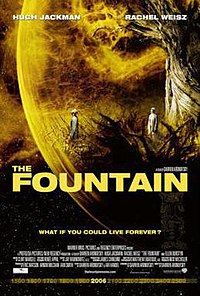
Pardon my French, but Darren Aronofsky sure knows how to fuck with people's heads in an immediate way. He's a director with a distinct visual style that manages to capture emotions with striking, visceral imagery. I haven't seen the film that made his name, Pi, but I distinctly remember watching his lyrical ode to self-destructive addiction, Requiem for a Dream. If you haven't seen it, let me summarize my initial feelings once the credits roll: "Fuck me." You will want to go into the shower, curl into a ball, and cry like a starving, sick little African child after watching Requiem. Yes, that is a recommendation. And again, pardon my French.
Inside of a minute, Aronofsky establishes The Fountain's theme of circles in about ten different ways. The circular head piece of a staff, the crown of a queen, a crest in the floor. Circles, circles everywhere. He's not shy about letting the audience know that this film isn't a one-way trip. There's the past story about the Spanish conquistador looking for the Tree of Life, the present-day story of a doctor looking to cure his wife's cancer, and the future story of the strangest damn astronaut you ever did see using the Tree of Life as a spaceship to reach a nebula of life-giving stars. And it's not even that simple. Each story affects the others in direct and indirect ways, some you see coming, others completely unexpected. Aronofsky and his co-writer, Ari Handel, maintain an emotional and symbolic logic to drive the story. It doesn't make sense, per se, but it maybe kinda sorta sometimes does.
While there are distinct parallels between the future, past, and present stories, the present day vignette could have existed as a film all by itself, especially since the "past" story is actually a novel-in-progress in the present. What I especially appreciated is how tapped in it is to raw, strong emotions. It's involving and heartrending, with Thomas's desperation consuming him. His drive to cure his wife is what keeps him at work and away from her. His desperation is palpable. I don't know why Hugh Jackman isn't a bigger star than he is, because he's terrific. (Plus, his name is Hugh Jackman. He can go up to girls and say in his exotic Aussie accent, "Hey, baby, I've got a Hugh Jackman, if you know what I'm saying. Don't Hugh wanna be Jackman'ed?" By the way, why do future sci-fi protagonists always speak American English? Why not the Queen's English or Aussie? Or, God forbid, something other than English?)
Where The Fountain leaves you wanting more is, unfortunately, the 3rd act. It's something in the vein of 2001: A Space Odyssey, an ending that makes sweeping, bold thematic gestures without giving the ripe emotional undercurrent of the preceding scenes. It's not a cheat or a trick, but it's not wholly satisfying either. I was mostly perplexed, but not to the point of not caring. The film sticks with you because it's a mind bender with an emotional core. It leaves the job of connecting the dots to the audience, and in turn, has you thinking about the things people pursue, the ceaseless drive towards finishing, and the links between the end of something and the beginning of something else.
It's like finding an old puzzle and putting it together, only to realize you're missing quite a few pieces. The big picture is there, you can see it, but it'd be nice to have it all down. And maybe after repeat viewings the other pieces will emerge. The good news is I want to find them.
30 November 2007
Cinematical's Asian Sensations (sort of)
Cinematical has a list of Asian-American actors on the cusp of kinda sorta stardom in a steady-roles-that-aren't-generic-bit-parts way. Aw, shucks, Cinematical... you make me semi-ashamed for being a white-washed fan of mainstream Hollywood. Thanks for the shout out.

14 November 2007
Grindhouse
Asking me for my favorite film is an exercise in futility. Even a Top 5 is tough, as it often just depends on my mood. If there's one thing I've learned about the moving picture, it's that movies hit you differently depending on when in your life you've watched them. I used to love Top Gun with every fiber of my being when I was eight, in large part because I had no concept of the French Kiss. Watching Tom Cruise and Kelly McGillis tongue-bathe each other in soft blue lighting was an earth-shattering cinematic revelation for me. Nowadays? Not so much.
However, if you ask me why I've pursued a career in film, what movies made me want to MAKE movies, the answer is easy. Pulp Fiction and The Usual Suspects. Hands down, no contest. I watched them and thought, "Wait, you can do that in a movie?" Each flick, in its own way, questions the films that came before it, acknowledges and re-invents genre conventions, and finds unique ways to kick ass.
Death Proof's faults are a lack of storytelling basics. There is no clever reinvention, no freshening up of dusty genre cliches. It's four girls yapping, followed by another four girls yapping. For two hours. And every now and again, Kurt Russell and his death proof mobile drop in to make things exciting.
And don't get me wrong, things get exciting when the titular car makes an appearance. The raucous, road raging finale delivers on the guilty pleasure promise of the whole grindhouse notion. It's genuinely thrilling to watch two types of car fetishes literally ramming into each other on a winding two-lane road. Unfortunately, the vast majority of the film is content to be about girls in conversation. And not the wonderfully sly, lyrical conversation Tarantino is known for. The conversations aren't unique, don't wind back on themselves, don't come up again later, or reveal anything about the characters. It's dreadfully natural chatter, bland in its realism. Oh, sure, there's a vague thematic connection, but who wants thematic mirrors when you've been promised killer cars?
I remember the mid-90s when Tarantino and Robert Rodriguez burst onto the Hollywood scene. Tarantino was the Golden Child, the post-classical Hollywood auteur. He was the trendsetter to Rodriguez's raw, brash director prodigy. The knock on Rodriguez was always that he could direct the hell out of anything, but couldn't write a story to save his life.
The film is a delightfully rich ball of cheese. It's the type of movie that's unafraid to beat a testicle joke to death, to repeat dialogue for melodramatic effect, or to amputate it's heroine's leg and replace it with an automatic rifle/rocket launcher. While Death Proof goes through great pains to recreate certain grindhouse elements (the scratched, dirty film stock, poor editing, etc.), Planet Terror actually relishes in the ridiculousness of action/horror movies. Tarantino delivers a tip of his cap to a by-gone genre of film, but Rodriguez goes all out and makes a film that stands on its own cheesy, gory merits.
31 August 2007
"One bag, plus the guns. I'll make pancakes."
Through divine intervention (or a friend of a friend), I managed to watch the pilot for Fox's slated 2008 hour-long show, Terminator: The Sarah Connor Chronicles. That's T:tSCC for you geeks.
I love Terminator and T2, and I'm very happy that the rumored third film never came to fruition. Whatever did happen to that alleged third film? I could've sworn it was shot, but for some reason I can't recall any of it. Kinda like the prequel Star Wars trilogy George Lucas said he'd do but hasn't yet. Boy, I hope the rumors are true and Lucas casts Leo DiCaprio as Anakin Skywalker. He'd be good. Anyway.
For the fans out there, your worst fears have not come true. The pilot (which I hear is undergoing reshoots) is solid. It actually kicks some ass. The opening shot is of those familiar headlights on a dark road, which dovetails into a Sarah Connor nightmare that recalls more iconography -- nuclear holocaust and T-800 skeletons. The show quickly settles down to reveal the strict, regimented life of Sarah and John. Sarah's nightmare has sufficiently spooked her into wanting to take John and run from a home that includes a sweet fiancee. Despite John's protests, Sarah coldly tells her son, "No one is ever safe. Half an hour. One bag, plus the guns. I'll make pancakes."
While I'm pleasantly surprised that the official title of the show has "Terminator" in it, it really should be called The John Connor Chronicles, because at this point the writing begins to focus on the dilemma of the future savior of mankind: be a kid or be a soldier. As played by Thomas Dekker (who had the recurring guest role of Hayden Panettiere's friend Zach on Heroes), John is torn between the allure of a normal teen-aged life and the dire warnings of his mother. He has an easy chemistry with Summer Glau, who plays a cute girl named Cameron (as in James) at John's new school. His awkward confession about his parents is sweet and endearing, and is the kind of emotional territory the show can use as a solid foundation.
And just as I'm appreciating the emotional groundwork the pilot is laying, shit hits the fan. By the end of the pilot, the requisite good and bad terminators have appeared. The clever aspect of having the show from Sarah and John's point of view is that constant, ominous threat every other human provides. Anyone can be a terminator in this world.
The action is almost non-stop from the point the terminators come into the story, and this is where the pilot really clinched my fanboy adoration. There's a distinct feeling that writer Josh Friedman and director David Nutter truly love and respect James Cameron's original world. The hand-to-hand fight choreography between the terminators distinctly mirrors the face-offs between Arnold and the T-1ooo. Miles Dyson's wife and son ("Danny? Dann-eeeee!") have a brief but heart-wrenching reunion with Sarah, who they think murdered Miles. The original films' linchpin is a time machine that is never seen, but Friedman cleverly works it into the pilot's plot. But the show doesn't just want to rehash what Cameron did. One inspired sequence toward the end of the episode has the good terminator assembling hidden gadgets into a ridiculously cool weapon, and it's revealed that an engineer from the future was sent back to the 1960s explicitly to build and plant technology that can be retrieved in the 1990s. There's an underlying excitement in exploring new aspects of the original world that's very alluring.
While one staple of the films -- epic, kinetic action sequences -- is hindered by the TV budget, there's enough tension and invention in the writing to make the production go. And the true core of the story, the mother-son relationship, is dealt with in quiet, endearing exchanges. While some of the dialogue errs on the cheesy and a subplot involving an FBI agent on Sarah's trail appears to already be running out of steam (how long can he NOT believe Sarah's crazy tale of the future?), there's good stuff here. And while this picks up where T2 left off, it sure feels like the show will end up rewriting that third movie that we don't talk about and doesn't exist. I'm not quite certain what these characters will be doing on a weekly basis, as their search for who picked up Skynet's research isn't given a lot of momentum in this pilot. But these characters are alive and well, so I'll be back... er, I'll be down for watching more.
PS - If you want to quibble about story continuity... it's fine. The 1992 film actually does take place in 1997, where this picks up. And I don't want to spoil it, but this world does revolve around... wait for it... time travel. I know, I know... Just shut up and watch it, dude.
PPS - Sarah Connor is played by Lena Headey, who is gaining serious geek points. She works with Terry Gilliam, co-stars in 300, and then takes the role as Sarah Connor. And she's no slouch in the looks department (looks strikingly like Naomi Watts in this, too).
Oh, what, you still think Alba's hotter? How many times have you seen 300? Now, how many times have you seen Honey?
Thank you.


