
It’s a terrific conceit that leaves aside the standard cliches of war adventures. There is no bond of brotherhood between soldiers here, or subplots involving broken loyalties, or the glory of battle. There are paintings by Renoir, Degas, Cezanne, Picasso, and Matisse. There is Col. Von Waldheim, a ruthless German officer who appreciates them, and Labiche, the gruff, no nonsense member of the underground who does not. When the museum curator informs Labiche of Von Waldheim’s plan, he bluntly points out how he’s running low on men and asks if she has copies of the paintings. When told that the fallen members of the underground would’ve wanted to save the art, he responds, “And they're dead. And they'll never know!”
There’s lots of nifty action, with trains derailing and colliding and whistling and squealing, all of which is a childhood dream come true for any outrageously swarthy dude who ever had a train set. In one scene, Lancaster slides down a ladder, gets up a head of steam, and jumps aboard a passing train -- all in one shot by Frankenheimer.
It’s a lean and mean affair that unfolds like one long shell game, with Labiche and his cohorts trying to trick the German officers onboard that the train is en route to Germany when, in fact, it is looping back toward Paris. I enjoyed the tricks the French Underground employed to fool the German officers, and the numerous, sometimes ingenious ways Frankenheimer finds to make a train running along tracks exciting. At one point, Labiche must bring an engine from one station to another in broad daylight, and he soon comes under fire from a British fighter that, of course, does not know a swarthy American playing a French saboteur is at the helm. The ensuing scene becomes a race to a tunnel, with Labiche getting the engine up to top speed and then having to slam on the brakes to avoid being strafed.
Another twist involves Labiche’s having to paint the roof of the train so that future Allied air attacks can identify it and let it be. While the bulk of the film focuses on these and other tactics, what really grounds the action is the constant question: is it worth it? The more Col. Von Waldheim is undermined, the more vicious he becomes. At several points, dozens of civilians are lined up and shot without hesitation. Von Waldheim is a terrific villain, a ruthless man of culture who is a great foil to Labiche. At one point he tells Labiche, “The paintings are mine; they always will be; beauty belongs to the man who can appreciate it.”
The film succeeds because it balances the swift action and clockwork plotting with these brief exchanges about the value of art and culture. “This is our pride, what we create and hold for the world. There are worse things to risk your life for than that” argues the museum curator early in the film. Labiche says he can’t help her, but he does. Because that’s what swarthy dudes do during war.
22 April 2009
The Train (1964)

06 March 2008
Atonement
First of all, to the marketing genius who decided to score the Atonement DVD commercials with Timbaland's "Apologize" -- stop taking your teenaged daughter's advice on ad campaigns. And stop going through her cabinets and smoking whatever drugs you find. They're hers.
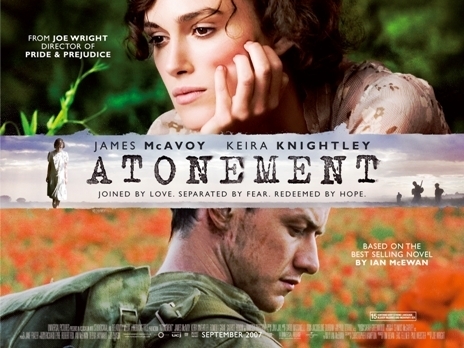
Speaking of marketing, Atonement reminded me why it's good to never see a trailer, read a review, or otherwise know anything about a film before seeing it. I thought it was going to be a schmaltzy romantic throwback involving separated lovers, old English class conflicts, glorious depictions of the French losing World War II, period costumes galore, and misty-eyed love letter voice overs. And it has all that. But the story of Atonement's tragically separated lovers is anything but old school by virtue of its structure. The film begins with the eyes of young Briony, a precocious young teen with a fertile imagination and a penchant for writing. An early sequence cleverly indoctrinates the audience to how this story will unfold. There is an encounter between Briony's prickly older sister Cecilia and Robbie, the son of the estate's housekeeper, that Briony thinks is menacing, but the film replays the events for what they are: the contentious spark that reveals a friendship to be romance. A number of events in the film's first act play out in this fashion, and it feels like a clunky device until Briony witnesses an ugly crime. The only way her young mind can make sense of it is to pin it on the seemingly lewd and uncouth help, thus condemning Robbie to prison and, later, the army.
The ensuing scenes of heartbreak and emotional devastation against the backdrop of a generation-altering war are beautiful in their sweep. The single-take sequence of harried British troops on the beaches of Dunkirk is grand cinema. However, it's the film's ending that pulls everything together. Twists that change the context of every scene that preceded it tend to fall flat on their faces. More often than not, they're cheap gimmicks that essentially boil down to the filmmaker's saying, "Hey, those last two hours you just watched? I was kidding -- this is what really happened." For examples of how a twist like this can go horribly awry, see Abandon and Lucky Number Slevin. Or take my word for it and don't see them because they suck.
Atonement's twist (for lack of a better word) is rooted in the character work, in the foundation laid in the opening scenes, in the thematics, and even the title. It's an affecting piece that had me thinking about it long after the credits rolled, about Robbie's simple mistake of honesty that brought two people together, and how the confused imagination of a young girl destroyed two other lives. I especially appreciated how the story doesn't try to explain Briony's motivations. Her convoluted version of the truth is equal parts jealousy, fear, and immaturity. The notion that she can only amend her lie by devoting her life to writing fiction is what pushes Atonement beyond a simple love story. The film starts as an engrossing romantic tragedy and ends as a provocative view on the sticky relationship between truth and fiction, and the muddy distinction between fiction and lies.
On another note, please give the Amazon.com mp3 store a look. I downloaded the lovely Atonement soundtrack from there (which uses the pounding sound of a typewriter to good effect) and now listen to it in it's DRM-free, 256 kbps glory. They don't yet have the selection of iTunes and the interface isn't as slick for browsing, but they deserve props for forcing the record companies' hand and dropping the handcuffs of DRM. Of course, iTunes is still tops for organizing music, especially if you're not one of the two people who own Zunes, but competition is always fun, so keep it up, Amazon.
14 November 2007
Grindhouse
Asking me for my favorite film is an exercise in futility. Even a Top 5 is tough, as it often just depends on my mood. If there's one thing I've learned about the moving picture, it's that movies hit you differently depending on when in your life you've watched them. I used to love Top Gun with every fiber of my being when I was eight, in large part because I had no concept of the French Kiss. Watching Tom Cruise and Kelly McGillis tongue-bathe each other in soft blue lighting was an earth-shattering cinematic revelation for me. Nowadays? Not so much.
However, if you ask me why I've pursued a career in film, what movies made me want to MAKE movies, the answer is easy. Pulp Fiction and The Usual Suspects. Hands down, no contest. I watched them and thought, "Wait, you can do that in a movie?" Each flick, in its own way, questions the films that came before it, acknowledges and re-invents genre conventions, and finds unique ways to kick ass.
Death Proof's faults are a lack of storytelling basics. There is no clever reinvention, no freshening up of dusty genre cliches. It's four girls yapping, followed by another four girls yapping. For two hours. And every now and again, Kurt Russell and his death proof mobile drop in to make things exciting.
And don't get me wrong, things get exciting when the titular car makes an appearance. The raucous, road raging finale delivers on the guilty pleasure promise of the whole grindhouse notion. It's genuinely thrilling to watch two types of car fetishes literally ramming into each other on a winding two-lane road. Unfortunately, the vast majority of the film is content to be about girls in conversation. And not the wonderfully sly, lyrical conversation Tarantino is known for. The conversations aren't unique, don't wind back on themselves, don't come up again later, or reveal anything about the characters. It's dreadfully natural chatter, bland in its realism. Oh, sure, there's a vague thematic connection, but who wants thematic mirrors when you've been promised killer cars?
I remember the mid-90s when Tarantino and Robert Rodriguez burst onto the Hollywood scene. Tarantino was the Golden Child, the post-classical Hollywood auteur. He was the trendsetter to Rodriguez's raw, brash director prodigy. The knock on Rodriguez was always that he could direct the hell out of anything, but couldn't write a story to save his life.
The film is a delightfully rich ball of cheese. It's the type of movie that's unafraid to beat a testicle joke to death, to repeat dialogue for melodramatic effect, or to amputate it's heroine's leg and replace it with an automatic rifle/rocket launcher. While Death Proof goes through great pains to recreate certain grindhouse elements (the scratched, dirty film stock, poor editing, etc.), Planet Terror actually relishes in the ridiculousness of action/horror movies. Tarantino delivers a tip of his cap to a by-gone genre of film, but Rodriguez goes all out and makes a film that stands on its own cheesy, gory merits.
20 September 2007
"Only The Brave" & Kouraku
I really, really wanted to like Only The Brave, an independently-financed film about the most highly decorated unit in US military history, the 100th/442nd Regimental Combat Team comprised of Japanese-Americans, most of whom were sent to internment camps in the wake of the Pearl Harbor attack. It's an amazing story, a uniquely American story, and a real shame that it hasn't been told in the mainstream before. Most World War II texts gloss right over it. The fact that Only The Brave is written and directed by a Japanese-American filmmaker, Lane Nishikawa, makes it all the more significant. And all the more disappointing.
The film is actor-writer Nishikawa's directing debut. It shows, especially during the war scenes, as his camera has trouble navigating the chaos of the battlefield. It's hard to criticize him for not having enough money (narrow-minded film executives are to blame there, but that's another topic), but the budget limitations are evident. Visually, there's little urgency to the war stuff. Which soldiers are where, and where they are going, and what's in their way... it's all muddled and flat.
I'd like to say that the battle sequences are ancillary to the story of these brave volunteer soldiers and their journey from the internment camps to the army, but it isn't. The bulk of the picture is focused on the 100th/442nd's rescue of the "Lost Battalion," a unit surrounded by German forces in October 1944. The entire context of the internment of US citizens for no other reason than racist paranoia is relegated to a crawl of text during the opening moments of the film. If you were to walk in late to this film, you might not know at all that it's about soldiers who overcame blatant discrimination to join the army and serve the very country that maligned and repressed them.
Part of the trouble is the driving force of the film is explored with cryptic strokes. Jimmy, the platoon leader played by Nishikawa, is first seen as a veteran haunted by his memories. However, his relationships with his men are cold and conventional. There's little chemistry between the characters because they do little together save for stalk through the forest. There are poignant flashbacks spread intermittently throughout, featuring each of the soldiers saying their goodbyes to their families. One in particular, with one soldier receiving a "1,000 stitch" scarf that carries the well wishes of an entire community, strikes a heartbreaking cord. These share other details and give some shading to what are otherwise faceless soldiers, but they aren't enough to sustain the prolonged battle sequences and serve only to convolute Jimmy's story.
It's evident that Nishikawa wants to honor the veterans of the 100th/442nd by telling their story without melodramatic touches or fifty years of hindsight. The tone of the film is stoic, immediate, and the filmmaker has a fondness and a good ear for the soldiers' banter between battles. However, as a whole, it all feels raw and incomplete. Jimmy's haunted looks are never fully explored, undermining an intriguing absolution. As a historical retelling, Only The Brave misses the mark, and as drama it's convoluted and underdeveloped.
The Los Angeles screening I went to was the kick-off of a national tour promoting the DVD. Visit the film's website for more info.
After the film, Camille and I wandered through J-Town looking for some eats. (Isn't "J-Town" much cooler than "Little Tokyo?" Come on, try it on for size.) We thought the wise thing to do was follow a crowd, so we walked into Kouraku, a quaint place with the menu written in dry erase on the wall and counter seating fronting the kitchen. Of course, the dry erase wall menu was in Japanese, so we had to peruse the surprisingly vast table menus. They seem to specialize in noodles, so we both went for ramen with an appetizer of squid cooked in butter.
Squid can easily become rubbery and gross, but here it was fresh, soft but with a nice bite, and butter-rific. I don't think I can overemphasize how deliciously buttery the butter on the butter squid is. Butter butter butter. So simple and fantastic.
I went for a shrimp omelette ramen in a soy-flavored broth. First and foremost, the broth brings the goodness. Warm, smooth, and a touch sweet and salty. While I'm a tremendous fan of putting a fried egg on pretty much anything, I've never considered making an omelette... and then dropping it onto soup. The shrimp omelette by itself would have done the job, but the plain sweet flavor of the shrimp and egg in the middle of a rich broth, combined with the soft noodles is thoroughly satisfying.
Camille had a more hodgepodge soup that contained an array of proteins in a different kind of broth. I think satisfying is probably the best word for this food. Not fantastic. Not mind blowing. Satisfying. Looking at the menu, it's enticing to see that every soup dish describes the different broth they use. I think we'll be coming back.

314 East Second Street
LA 90012
213.687.4972
cash only


