
I was emotionally exhausted after screening it. Watching that slimy, wily Billy Mitchell defend his high score is like watching the Yankees buy another All Star. Or Ivan Drago juicing in Rocky IV. Or Kreese telling Johnny to sweep the leg. Occasionally, movie villains come along that audiences love to hate. Billy Mitchell is not one of those villains. I wanted to strangle him. The fact that he is a living, breathing, bona fide real person makes me livid.
I'd rate The King of Kong as one of the best sports movies in recent years. And at first blush, it's probably up there with the all-time great sports flicks. Sure, the inspirational, based on a true story movies like Miracle, Rudy, and Hoosiers stand out, especially since they are about monumental moments in athletic lore and not about a video game. But I can't think of another film that so thoroughly and effectively captures the dynamics of competition, the cliques that form, and the often juvenile means in which competitors view each other and define themselves. How many sports fans quantify their team's wins and losses, not content to let the scoreboard be the defining element it is supposed to be? How many purists are loathe to compare generations, always claiming that theirs was the toughest? The King of Kong illustrates how a level playing field is a completely subjective notion.
Things start innocently enough, revealing Billy Mitchell as a man not content to let go of his 15 minutes of fame, and Steve Wiebe as a man who never got close to a second of it. The tape that Wiebe submits of his first high score attempt, complete with his young child demanding Wiebe stop playing to come wipe his ass, is the kind of detail I expected. It's both hilarious and poignant, a portrait of childhood pursuits that never die. But the real meat of the proceedings comes next, when the governing body of video game scoring, Twin Galaxies (which could be subject of its own doc), refutes Wiebe's score. Did I mention that Mitchell, the poster boy of Twin Galaxies, is also one of the judges? And that he has an oily mullet and sells hot sauce?
How this involves Mitchell's unsettled rivalry with a man who calls himself Mr. Awesome is too... well... awesome to conceive. But it is Mitchell's truly Machiavellian responses to Wiebe's pursuit of a face-to-face battle that blew me away. You can't help but root for the hard luck Wiebe, in part because he does everything asked of him and more, and especially when Mitchell ducks him and sends a series of minions to do his dirty work. It's classic David versus Goliath stuff that exposes the very dark underbelly of this -- and really, any -- competition. The politics and nuances of this world are positively Shakespearean in their breadth.
To recap that last paragraph: competitive Donkey Kong = Machiavelli + Bible + Shakespeare.
This is not hyperbole. I swear, this movie is that good. The greatness of The King of Kong is how it reveals the complexities of competition, no matter how simple the rules. It finds the human drama in a twenty-plus year-old video game and underscores just how rivalries in sport never truly end, even if the game does.
Some people worry that kids are playing too many 1st-person shooters. They ought to watch this film.
For updates on their story since the completion of the documentary, check the film's official site: www.billyvssteve.com
25 March 2008
The King of Kong: A Fistful of Quarters

06 March 2008
PB&J Trio

I've always thought the comforting mush that is soft white bread, mashed peanuts, and jam could be dolled up into a pseudo-gourmet novelty. So, after my cheap, lazy ass got through two-thirds of the day with PB&J, I figured I'd go for the trifecta at dinner. And do it Iron Chef style.
PB&J Trio
Ingredients
four slices white bread
peanut butter
strawberry jam
grape jelly
guava jelly
sliced bananas (optional)
Equipment
sandwich maker or panini press
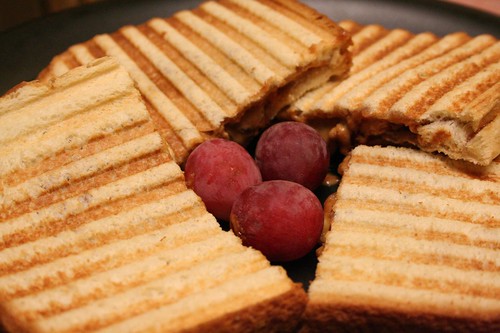
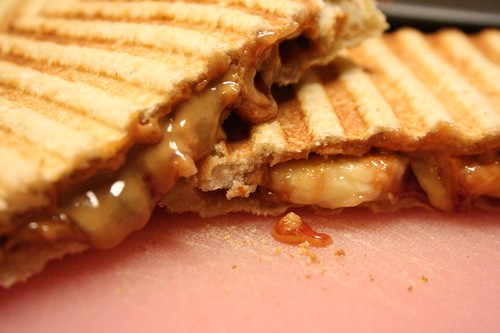
Plug in your machine and preheat. Slather two slices with peanut butter. Slather one slice with your preferred jam. Split the other slice between the remaining two flavors. If you're using a sandwich maker, be judicious with the fillings as they will become a superheated mash that will explode over your face. A panini press does a better job of melding everything together, so if you've got one (and you should), then go crazy.
I only used banana slices on half the sandwichs, so it's actually a PB&J Triple Trio. One thing I wanted to accomplish was eat grape PB&J and strawberry PB&J side-by-side and settle that argument once and for all. Of course, I grew up on the strawberry version, so I'm biased. But in my mind and in my mouth, the grape flavor is too distinct and doesn't meld well enough with the peanut butter. In grape's defense, the fact that it was jelly and not jam makes a huge difference. Jellies are generally too sweet and runny.
Interestingly, the bananas really dominated the strawberry jam and guava jelly. The guava was especially eye-opening. I brought the Hawaiian Sun guava jelly back from (drum roll...) Hawaii on my last trip, only to find it was exceptionally sweet. However, against the peanut butter and paired with the banana, the guava flavor almost disappeared and actually served to brighten the banana flavor.
The banana-strawberry was a little underwhelming. The two fruits always go together so well, and here I thought the starch of the banana would balance well with the sweet jam and creamy peanut butter, but the banana flavor tended to dominate. Also, the heat and pressure of being pressed softens the banana texture, effectively turning it into another jam and undermining my scientific hypothesis for including them to give the sandwich some bite. Thankfully, this science experiment still tastes good and remains cheap and comforting. The master stroke of this preparation is the crispy texture of the bread, which turns an old school comfort food into a warm, crunchy-gooey culinary pleasure. That's how I'd describe it if I were on Iron Chef, anyway.
Atonement

First of all, to the marketing genius who decided to score the Atonement DVD commercials with Timbaland's "Apologize" -- stop taking your teenaged daughter's advice on ad campaigns. And stop going through her cabinets and smoking whatever drugs you find. They're hers.
Speaking of marketing, Atonement reminded me why it's good to never see a trailer, read a review, or otherwise know anything about a film before seeing it. I thought it was going to be a schmaltzy romantic throwback involving separated lovers, old English class conflicts, glorious depictions of the French losing World War II, period costumes galore, and misty-eyed love letter voice overs. And it has all that. But the story of Atonement's tragically separated lovers is anything but old school by virtue of its structure. The film begins with the eyes of young Briony, a precocious young teen with a fertile imagination and a penchant for writing. An early sequence cleverly indoctrinates the audience to how this story will unfold. There is an encounter between Briony's prickly older sister Cecilia and Robbie, the son of the estate's housekeeper, that Briony thinks is menacing, but the film replays the events for what they are: the contentious spark that reveals a friendship to be romance. A number of events in the film's first act play out in this fashion, and it feels like a clunky device until Briony witnesses an ugly crime. The only way her young mind can make sense of it is to pin it on the seemingly lewd and uncouth help, thus condemning Robbie to prison and, later, the army.
The ensuing scenes of heartbreak and emotional devastation against the backdrop of a generation-altering war are beautiful in their sweep. The single-take sequence of harried British troops on the beaches of Dunkirk is grand cinema. However, it's the film's ending that pulls everything together. Twists that change the context of every scene that preceded it tend to fall flat on their faces. More often than not, they're cheap gimmicks that essentially boil down to the filmmaker's saying, "Hey, those last two hours you just watched? I was kidding -- this is what really happened." For examples of how a twist like this can go horribly awry, see Abandon and Lucky Number Slevin. Or take my word for it and don't see them because they suck.
Atonement's twist (for lack of a better word) is rooted in the character work, in the foundation laid in the opening scenes, in the thematics, and even the title. It's an affecting piece that had me thinking about it long after the credits rolled, about Robbie's simple mistake of honesty that brought two people together, and how the confused imagination of a young girl destroyed two other lives. I especially appreciated how the story doesn't try to explain Briony's motivations. Her convoluted version of the truth is equal parts jealousy, fear, and immaturity. The notion that she can only amend her lie by devoting her life to writing fiction is what pushes Atonement beyond a simple love story. The film starts as an engrossing romantic tragedy and ends as a provocative view on the sticky relationship between truth and fiction, and the muddy distinction between fiction and lies.
On another note, please give the Amazon.com mp3 store a look. I downloaded the lovely Atonement soundtrack from there (which uses the pounding sound of a typewriter to good effect) and now listen to it in it's DRM-free, 256 kbps glory. They don't yet have the selection of iTunes and the interface isn't as slick for browsing, but they deserve props for forcing the record companies' hand and dropping the handcuffs of DRM. Of course, iTunes is still tops for organizing music, especially if you're not one of the two people who own Zunes, but competition is always fun, so keep it up, Amazon.
27 February 2008
Stop-Stop-Play
I learned this one a while back while listening to super sweet tech news podcast Buzz Out Loud. (If you're into that stuff, please listen to them. You'll quickly find yourself in geek heaven.)
If you're annoyed by the endless amount of previews on DVDs, every DVD player has this nifty feature built in to skip straight to the feature presentation. Simply press stop, press stop again, then press play. Your player will then skip to the main feature. It may flash an FBI warning or other such legal babble, but otherwise you're home free.
So, when you're mired in a seemingly endless montage of a studio's action movie back catalog edited to Bonnie Tyler's "Holding Out For A Hero," just remember to hit STOP-STOP-PLAY on your remote.
(You think I'm joking. One of my Paramount titles has it, complete with Harrison Ford in Witness ducking out of a grain silo with a shotgun. It's actually quite glorious.)
20 February 2008
Surfas Restaurant Supply & Valentine's Day
It seems there's a frozen food for every level of foodie. Convenience stores have those wonderfully cheap Tina's frozen burritos. Supermarkets take it up a notch, with everything from Michelina's (my college preference) to Lean Cuisine and Smart Ones (Camille's work food of choice) to those frozen pasta bags that actually resemble real food after some time in a frying pan. Trader Joe and trader pals Jose, Ming, and Giotto have stuff that you could seriously fool people into thinking was more expensive.
And then there's Surfas Restaurant Supply in Culver City, which is more expensive and could seriously fool people into thinking you're some kind of chef. In fact, when I went to buy my Valentine's Day dinner ingredients, the kindly clerk asked, "Are you a chef?" Apparently, duck confit, dried figs, juniper berries, and foie gras are not the normal purchases of, say, aspiring screenwriting foodies who blog in their spare time.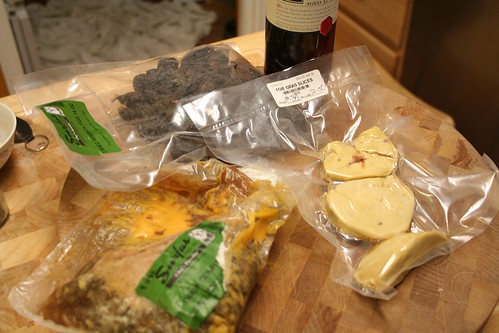
Anyway, I'd planned on only buying foie gras, but being in Surfas is being the proverbial kid in the candy store. The fridge and freezer section alone contained numerous items of culinary holiness like creme fraiche, duck fat, rillettes, and, yes, frozen duck confit. Confit is another dish I've wanted to try, except it's one of those things that requires a lot of lead time, what with the curing in salt for days. Now, in the time it took me to grab the frozen duck and foie gras out of cold storage, I had pretty much finished my main dish. And get mistaken for a chef, no less!
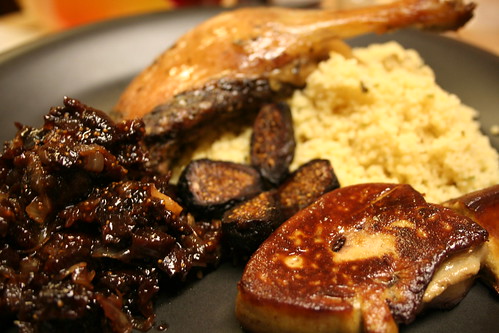
Duck confit, seared foie gras, fig and port charoset, pine nut cous cous.
The thing that puts seared foie gras over the top is the texture. Yes, it's creamy and rich, but searing it properly gives it a crust and a lovely bite. It crunches slightly, then melts in your mouth. All geese should have the good fortune of exiting the world in this fashion.
According the the Epicurious recipe I got, the fig and port charoset is apparently a staple of Jewish seder. I don't know anything about that, but it ends up being a sweet, sticky fig chutney mush which works really well as a side dish. Plus, you'll have an open bottle of port begging you to finish it off while you're cooking, which is just fine and dandy.
The first two ingredients are cheats. Of course, cous cous is insanely easy, so it's not much of a shortcut to buy the prepackaged box. As for the confit, there's that curing in salt business. Yeah, no...
Ingredients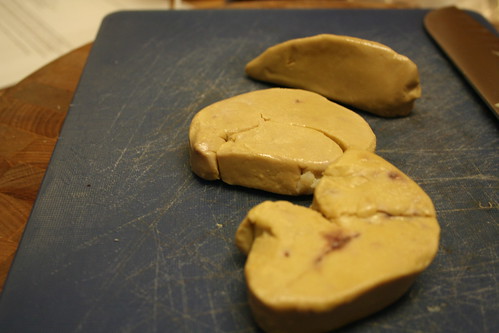
1 package pine nut cous cous
1/3 lb. foie gras (about two 1" slices)
1/2 cub dried figs, chopped
1 medium onion, chopped
1 cup port wine
3 tbs. vegetable oil
1 tbs. butter
Equipment
oven
2 small pots (seriously, who calls small pots "saucepans?")
1 frying pan
Preheat oven to 375.
Place duck confit into the oven and bake 20-25 minutes. Good job, chef.
Combine port and figs in small pot #1, bring to a boil, then reduce to a simmer for 15 minutes. Meanwhile, heat the oil over medium-high heat, add the onions, and cook, stirring often, until the onions lightly caramelize, about 15-20 minutes.
Place the onions in a bowl and let cool slightly, add the port and figs, and mix. Add pepper to taste. Set aside.
Cook the cous cous. It should take about 6 minutes tops.
Turn the oven off, flip on your broiler, and move the duck confit to the top rack just underneath. Broil for 1-2 minutes until the skin is crisp. Remove and let rest.
Wipe down the frying pan (or use a fresh one) and melt the butter over high heat until the bubbles subside. Lay in the foie gras slices and sear for about a minute. Flip and repeat. In order to quasi-sear the sides, tilt the pan so the butter pools in one end, then use your spatula to splash the hot butter over the foie gras. Remove to a paper towel to drain.
Plate and serve.