 Your reaction to Wanted will depend largely on how you handle the Loom of Destiny. It's a machine at the center of the Wanted universe and a big linchpin in the plot. It tells the Fraternity, the society of assassins in the story, who to kill next via irregularities in the stitching that are actually coded messages.
If you're confused, yes, it's that kind of loom. A machine that weaves yarn into cloth. This is an action movie about a millenia-old underground society of superhuman killers who restore balance to the world based on the machinations of a device that makes sweaters.
If you can buy that, you're going to love Wanted. Me, not so much.
I had mixed expectations about the film going in. The imagery left me cold, but then the reviews starting pouring in and praising director Timur Bekmambetov for his inventiveness and flair. Apparently, he was given an uncanny amount of freedom, especially for a foreign director making his English-language debut with a big budget Summer flick. And at one point during the film, I thought to myself that Bekmambetov was Michael Bay with a sense of restraint. He has a feeling for when to let a scene breathe versus when to go for the craziness. The first big action sequence specifically is full of energy and excitement, what with a confused Wesley (James McAvoy) being literally swept away at 100 mph by Fox (Angelina Jolie -- really, that's her character name) and her Dodge Viper. Jolie proceeds to lie on the car's hood so she can steer with her feet and shoot backwards at the bad guy. The sequence has a visceral quality that all great action sequences should have -- speed, momentum, a sense of danger.
And then in comes the Loom of Destiny. Which, again, is a machine that weaves yarn.
There's something so obligatory, so plain, so by-the-numbers about Wanted's storyline that keeps Bekmambetov's visual flair from succeeding. The screenplay pretends to be about Wesley's search for an identity, a search ignited by the revelation that his father was the world's best assassin, but all we get is a lackadaisical training montage highlighted by pretty CGI bullets dancing through the air in slow motion. The story then throws away all established themes and logic for the sake of plot twists that are supposed to be eye-opening, but are instead confounding and empty. Basically, the film tramples all over its first half in order to fill the second half with twists that lack sense. Wesley supposedly is following in his father's footsteps, but the film is too busy to note how he feels about this, instead giving us cryptic backstory for Fox and underwhelming lectures about the Fraternity's role in the world. At the center of it all is an air of myth and mysticism in the form of a machine that turns cotton into tablecloths.
For all the spectacular, inventive action, there's just as much that is hollow and superficial. Much is made of the bullet bending trick, especially for what it represents about Wesley's growth, but then that's that, and the plot keeps chugging along. Visually, there's something anti-climactic about watching two bullets slam into each other. Even the big finale is a letdown, involving an overly-elaborate scheme with bombs planted onto rats. I'm not sure if this strategy is supposed make Wesley clever or not, but all it basically accomplishes is to open the front door for him. Speed? Momentum? A sense of danger? No, no... we get bomber rats.
Wanted puts the fate of its characters, plot, and themes in the hands of the Loom of Destiny. The actors acquit themselves well enough, and some of the action is pretty cool, but at the end of the day, things hinge on a machine that knits. Who know who else knits? My mom.
10 July 2008
Wanted

19 June 2008
Maui, Part 2: Going Native
Read Maui, Part 1
Before coming to Maui, the only agricultural product I associated with the island was the Maui onion. And then only because they make Maui Style onion-flavored potato chips. When I say "they make," I am referring to the Frito-Lay division of PepsiCo. in Plano, Texas. (If you want to find any of their "Hometown Favorites" products, use their nifty item locator.) According to the ingredients list, there is indeed some Maui onion powder in the Maui Onion-flavored chips. It's the 13th of 15th ingredient listed, ahead of Hydrolyzed Proteins and Caramel Color, but behind Corn Maltodextrin, Monosodium Glutamate, Malic Acid, and that classic and most sacred of culinary components, "Natural Flavor."
I don't necessarily have a problem with eating mass-processed junk food. After all, Camille and I stayed in early on our first night, our jet lag-induced slumber interrupted by a dinner that consisted of a bag of Natural Flavor and Maui Onion Powder. But there is something to eating fresh and local, as I found out.
Of course, this is the tourist's dilemna: to find that definitively, quintessentially local thing before it gets dolled up, appropriated, outsourced, and repackaged as Totally Local, Brah! Some recreations are worthwhile (like, say, a luau), but others, not so much (floral golf ball 3-pack). What I'll take away the most from Maui is a sense of what it truly means to go local, at least as far as food is concerned. Nevermind where the purveyors, chefs, and waiters came from. Much of the best stuff Camille and I ate was from the land and waters of Maui.
Imagine that, eating food before it gets packed and shipped off to Plano.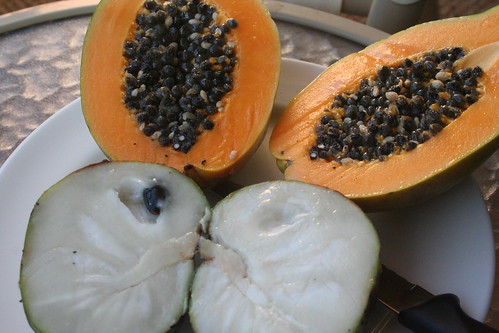
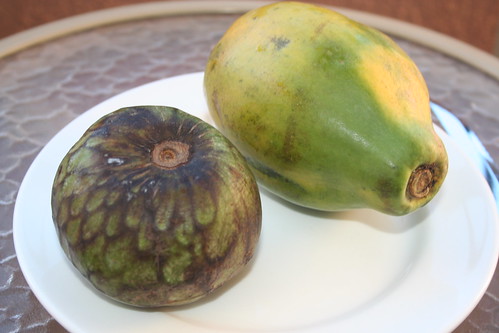
I'd never even heard of a cherimoya before this trip. It's a custard apple with a sweet, semi-pungent smell, and soft, sweet, white flesh that truly has the texture of soft custard. I spent the entire trip in Maui hoping to get a taste of fresh passion fruit, but the cherimoya sated my exotic fruit desires. Frankly, it's the damnedest thing I've ever eaten. It's Jell-o grown by a tree. And you know what they say about Jell-o.
By the way, you can thank Google for Calimoya, a cherimoya, passion fruit, avocado, and dragon fruit grower in the Santa Barbara area. Expensive, but will ship 2-day UPS when the fruits are in season. Have I overused the phrase "frakking fantastic" yet?
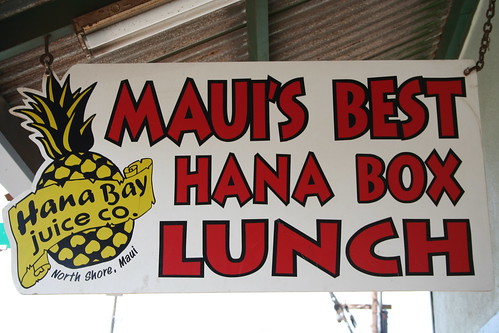
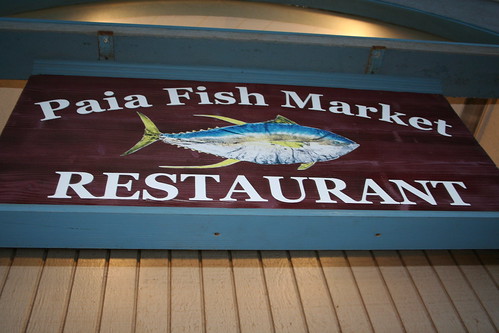
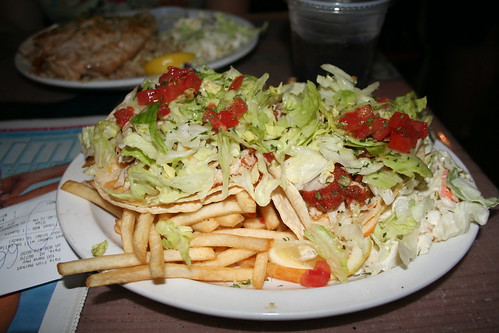
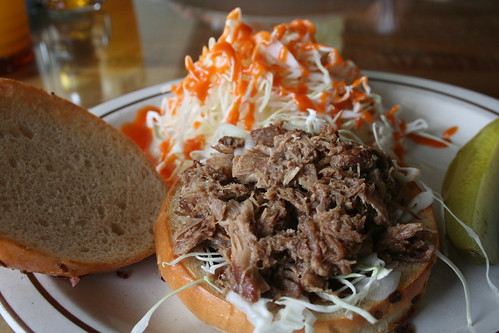
In terms of their food, they feature a lot of fresh and tasty fish. I had ono tacos. The slaw of roughage in the tacos was, as you can see, a little overwhelming, but it was all good. A fine, messy meal. Bonus points for heating the tortilla so it was slightly crunchy. Camille's opah sauteed in butter, white wine, lemon, and garlic was good if a tad too well done. (Fine woman that she is, she chose the meaty opah in anticipation that it'd be overcooked, knowing it'd retain some moistness.) 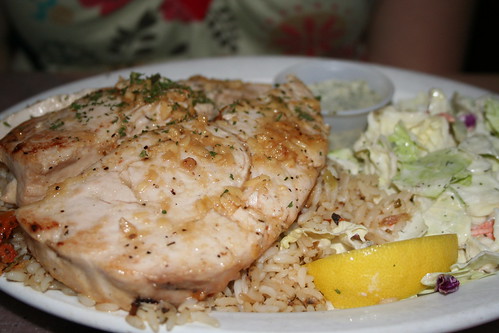
No, the truly local part of our trip didn't begin until our tours into Kula.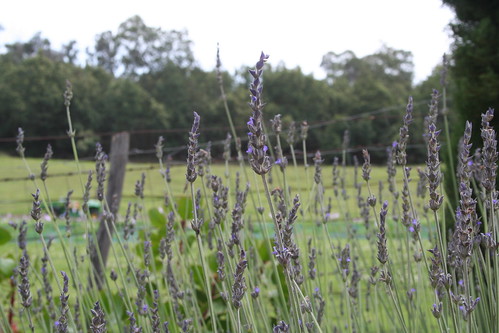
The AKL is 10.5 acres of serene, manicured gardens containing something like a kajillion types of lavender. Tours range from the free, self-guided variety (highly recommended) to a $12, 30-minuted guided walk and, lastly, an exclusive golf cart tour with grower Alii Chang. This last one is limited to five people per day, and for $25 bucks you'll have a dude whose first name is literally royalty talk your head off about a kajillion types of lavender.
The place is beautiful, don't get me wrong. There's something kind of mystical about Kula, all the lush, green rural land halfway up the slopes of a dormant volcano, and this farm is a fine place to stop and take it all in. But you can certainly do it for free with one of their photocopied guides to lavender, which we did. Camille and I had fun eating lavender scones and drinking lavender tea on the AKL Farm's quaint patio after perusing the many lavender-infused items in the gift shop. I recently used some AKL Farm lavender pepper to coat the skin on some pan-roasted chicken and also on shrimp, and it was good stuff -- a wise investment.
As for the scones... well, okay, they taste like scones. The lavender flavor in them could easily by in my mind. No, a more palpable and enjoyable way to eat the scones is to slather them with lavender lilikoi jelly. It's more than a dollar per ounce and we bought two jars. Sweet, tangy, and fragrant, it made the scones a delectable experience. Washing it down with lavender tea, which certainly does not skimp on the lavender, made for a wonderfully calming afternoon.
Lavender, by the way, is native to the Mediterranean, not Hawai'i. Strictly speaking, next to nothing is native to Hawai'i except dried lava. But one of the fantastic things about Hawaii that's very evident in Maui -- and especially in Kula -- is the fertility of the land. I couldn't really tell you what a microclimate is (though I'd hazard a guess that it means "really small climate"), but they got 'em in spades in Maui. Which is a good thing for farmers.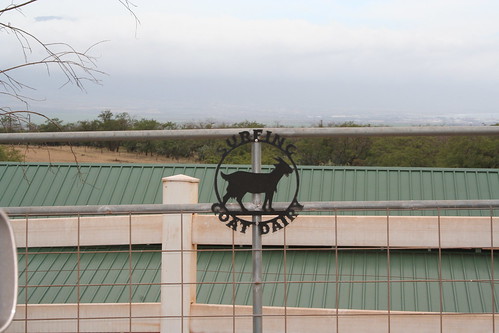
The tour is short and sweet: see milking equipment, see baby goats, see adult goats, see pot-bellied pig humping rocks, taste cheese. If we had the means to keep it cool, we would have definitely bought some cheese to bring home. Not to belabor the point, but all the cheese was super fresh, and in their relatively short time as a dairy, the Surfing Goat has certainly mastered ways to combine their creamy cheeses with some local flavors, like the lilikoi quark.
What I really liked more than anything else was realizing just how small an operation the Surfing Goat Dairy is. It really is just one family with a few hired hands, and in this day and age, it's admirable to see them pull that off. They even resist selling their older goats for meat, simply letting them retire to pasture for the rest of their natural lives. I have no idea if there are undiscovered local farms in the Los Angeles area, but I sure hope so, because it's something I'd definitely support.
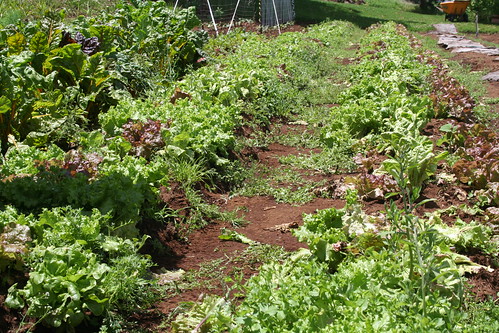
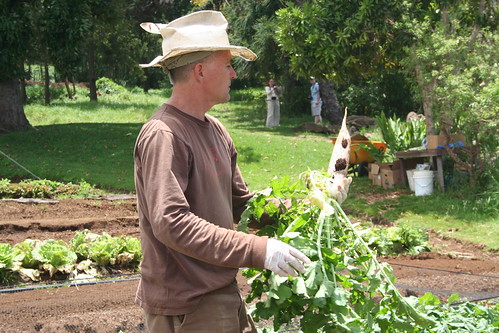
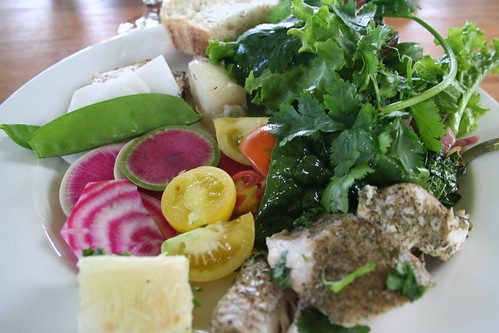
The tour is really informative and the meal is great, deliberately kept simple to highlight the assorted harvest. The place attracts a really interesting crowd, too, from agriculture and nutrition students to foodies on the hunt. The tour/lunch is limited to about 15-20 people, so do make a reservation early. It's a little pricey at $50 a person, but this is a whole lot more than gawking at lavender. This is food at its most elemental. The label "organic" gets tossed around so easily, so to see a living, breathing example of an organic farm is incredibly edifying. I had no idea what "compost tea" was, but I do now, and I think I'm a better eater for it. To see everything go from the ground to the table is more fun than I could have imagined. Beets never tasted so good.
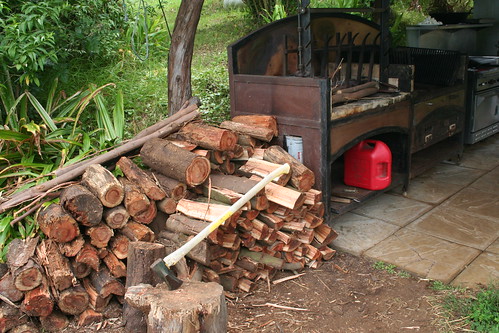
Plus, how often do you get a chef de cuisine from a highly rated restaurant to cook everything for you on an outdoor, wood-burning stove? Seriously, how cool is that?
Coming soon in Maui, Part 3: The other end of the O'o Farm food chain, plus the stuff I couldn't neatly tie into Parts 1 or 2.
Hana Bay Juice Co.
111A Hana Highway
Paia, HI 96779
(808) 579-8686
Paia Fish Market
110 Hana Highway
Paia, HI 96779
(808) 579-8030
paiafishmarket.com
Ali'i Kula Lavender Farm
1100 Waipoli Road
Kula, HI 96790
(808) 878-3004
www.aliikulalavender.com
Surfing Goat Dairy
3651 Omaopio Road
Kula, HI 96790
(808) 878-2870
surfinggoatdairy.com
O'o Farm (reservation required)
Waipoli Road
Kula, HI 96790
(808) 667-4341
www.oofarm.com

13 May 2008
Maui, Part 1: Kalua Pig & the Plate Lunch
Aloha! Let it be said that Camille and I aren't huge fans being in water. Which would probably present a problem for us when visiting Hawaii, except Hawaii has awesome food. Also, it's sunny and warm and lush and beautiful. But you knew that.
We went a year ago for a wedding and visited the Big Island and Oahu. It was a trip that laid the groundwork for this blog, but despite the endless pictures of food, I never got my thoughts down to clearly write about it. So, some real quick recommendations...
Big Island
Merriman's in Waimea. Chef/owner Peter Merriman is one of the twelve founding chefs of the Hawaiian Regional Cuisine movement, and this restaurant really lets the local ingredients shine. However, Merriman's Market Cafe in the Waikoloa resort/mall is very underwhelming. If you're interested in a great sandwich, head down to Island Lava Java in Kona and get yourself some coffee while you're at it. If you're in the market for some coffee beans, you'll have plenty of options. Mountain Thunder's very nice.
Oahu
The best plate lunch in Honolulu is Yama's Fish Market. It's not really near any tourist strips, which is a good thing. A wide variety of plate lunches (very good lau lau) to choose from, as well as a vast selection of poke. Matsumoto Shave Ice is an enormous tourist attraction in the North Shore town of Hale'iwa, and for good reason. They shave the ice down to a perfect, snow-like texture that you don't have to chew. I'd recommend adding ice cream and red bean, and hell, buy yourself a T-shirt. (By the way, any place on the island that offers "shaved ice" is a fraud.) On the way to Matsumoto's, you'll probably see the shrimp trucks parked along the road. Giovanni's Shrimp Truck loads on the butter and garlic for a great shrimp scampi. And if you bring a sharpie, you can scrawl your name on the graffiti-covered truck. If you're looking for fine dining and another one of those Hawaiian Regional Chefs, I highly recommend Alan Wong's in Honolulu. It's in a nondescript office building that you'll surely miss on first pass, but inside is terrific food terrifically served. I'm pretty sure we had a guy who's only job was to introduce the dish and suggest the ideal way of eating it. You'll pay for this type of thing in the end, sure, but it's always nice to have one fine dining night on a vacation. This year, we had another wedding to attend, this time in Maui. In the chain of islands, Maui sits between the Big Island and Oahu. In terms of energy and culture, I found Maui to be an interesting mix of Oahu's urban paradise vibe and Hawaii's lava-fields-with-beach-resorts thing. If I had to pick one word to describe Maui, it'd be rural. And if I had to pick a second word, it'd be immigrants. The locals who didn't work the tourist trade all seemed to work the lands. And in stark contrast to Oahu's markedly Asian demographic, a great many locals in Maui are, well... I believe the politically correct term is "whitey." Some of the Hawaiians who waited on us hailed from Huntington Beach, Irvine, and the Czech Republic. After returning from the lush road to Hana, we ate in the quaint town of Paia and were enveloped by European accents from all over. I have no hard data to back this up, but it sure seems like the people who decide to move to Hawaii end up choosing Maui. So it is that some of the best local food we had was prepared by a Seattle-raised sous chef and German goat cheese makers.
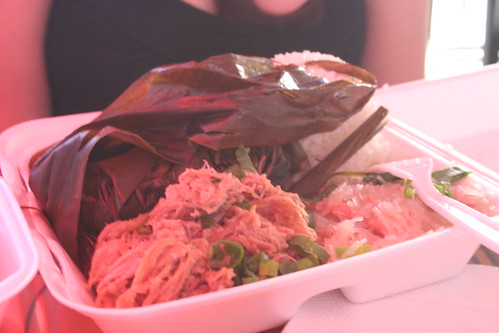
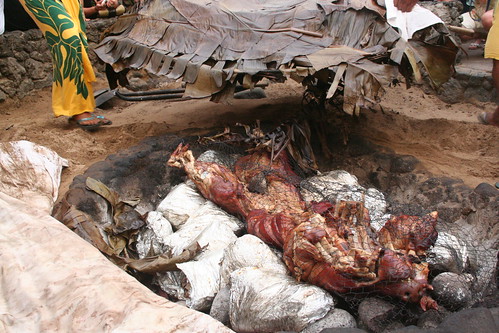
One of the most iconic things about Hawaii and Hawaiian food is, of course, the kalua pork at luaus. It's fast becoming one of my favorites, in part because of its simplicity: salt the pork, wrap, and roast for a long time. If you don't have the time, space, or inclination to dig yourself an imu, heat some stones, and bury a whole pig on top of it with some earth, then you can google yourself a recipe that will require liquid smoke and several hours in your oven.
I wouldn't say it's bad. In fact, the appetizer of coconut prawns was a very promising beginning to our trip. The sweetness of the shrimp and the nuttiness of the dried coconut go really well together, and for a deep fried food, it wasn't terribly oily. Combine that with our table right at the edge of Aloha Mixed Plate's cozy, oceanfront patio, and it sure seemed as if Pele was smiling down on our arrival. And then the plates arrived.
The lomi lomi and macaroni salad were fine enough. I didn't like the poi, but I've never liked poi, so I don't hold that against anybody. At first, I couldn't figure out what bothered me about the kalua, but after several fork fulls in my mouth, I slowly realized what was missing: some flavor. Way under seasoned. No smokiness at all. Even a little on the dry side. I tried some of Camille's pork lau lau, but it was the same. The ti leaf wrap adds a nice layer, but it was still bland. She noted that there wasn't much fat, and certainly lean pork might explain some of this, but at the end of the day, it was severely lacking.
I wonder if Aloha Mix Plate was having a bad day, because their sister establishment right next door, Old Lahaina Luau, had pretty solid food. Considering Old Lahaina Luau serves 500+ people every night, you'd think they would have the bland food. Then again, they actually make their kalua in the traditional way.
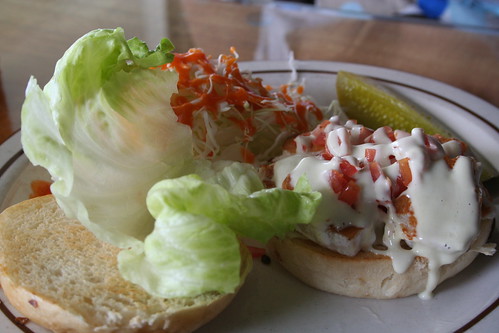
Kidding aside, they make a mean loco moco. Camille and I usually try not to order the same thing for the sake of adventure, but getting up at 3:30 am and racing the sun up to the top of Haleakala in a rented Corolla is adventure enough for us. We wanted filling, we wanted comfort, and we wanted it with a scoop of rice. Enter the loco moco, Hawaii's wonderful entry into the comfort food lexicon. A juicy beef patty topped by a fried egg (cooked to order, I like it runny), and the whole thing bathed in gravy. Those looking for a hearty breakfast can't ask for much more. If I lived in Kula, I'd probably eat here twice day, every day.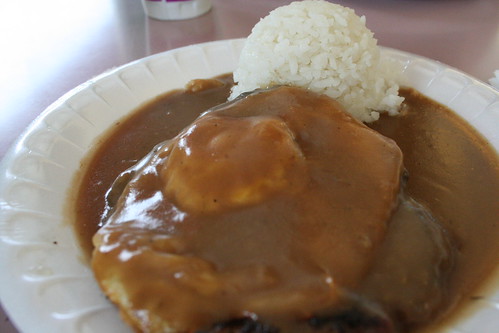

Click here to read Part 2: Going Native.
Aloha Mixed Plate
1285 Front Street
Lahaina, HI 96761
(808)661-3322
www.alohamixedplate.com
Old Lahaina Luau (reservations required)
1287 Front Street
Lahaina, HI 96761
(800)248-5828
www.oldlahainaluau.com
Da Kitchen
Rainbow Mall
2439 South Kihei Road #A107
Kihei, HI 96753
(808)875-7782
Triangle Square
425 Koloa Street #104
Kahului, HI 96732
(808)871-7782
www.da-kitchen.com
Kula Sandalwoods Inn & Cafe
15427 Haleakala Highway
Kula, HI 96790
(808)878-3523
www.kulasandalwoods.com
Cafe 808
4566 Lower Kula Road
Kula, HI 96790
(808)878-6874
Honokowai Okazuya & Deli
3600 Lower Honoapiilani Road #D
Lahaina, HI 96761
(808)665-0512
www.mauihawaii.org/restaurants/okazuya.htm

15 April 2008
pan-roasted chicken with li hing mango salsa

Apparently it's a dried plum. I've never seen it in its natural state. For all I know, it could be the by-product of slipper production deep in mainland China. Or dried lava from the ever-erupting Kilauea volcano. What you'll likely find if you venture into the dark heart of your local Asian market is a bright orange powder that's popular in Hawaii as a coating for dried fruits or candy. A quick Google search uncovers a shortbread, cakes, and li hing as accent on a cocktail. I think it's tremendous stuff. Sweet and sour and savory and really, really good on gummi bears.
But rarely is li hing found in an entree dish of any kind. Perhaps chefs of the world think the sweet-salty tang is too strong for proteins. Aloha Airlines offered a tomato-cucumber salad with ling hing mui vinaigrette from Alan Wong. And then they filed for Chapter 11 bankruptcy and no longer operate passenger service. Coincidence? Hey Alan Wong, the next time an airline asks for a Hawaiian dish for in-flight service, man up and pair li hing with the main course.
In fact, you can take my recipe if you like! I'd tried previously to integrate li hing into a cream sauce. Um... yeah... this isn't that recipe. This one I'm actually kinda proud of.
pan-roasted chicken with li hing mango salsa
Ingredients -- 2 servings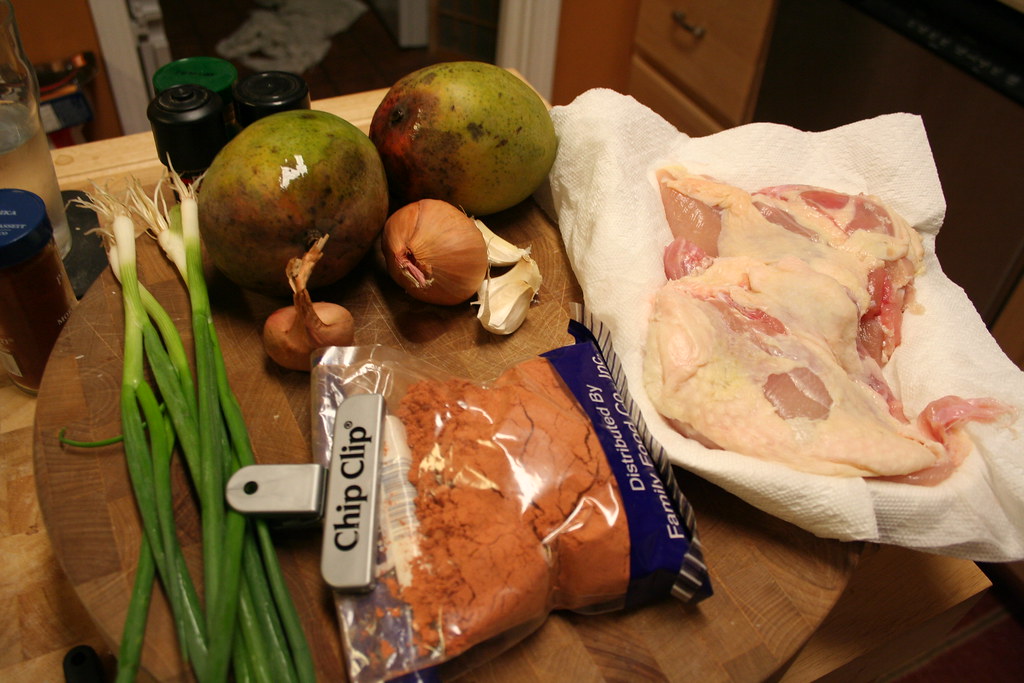
2 ripe mangos, cubed
2 scallions, chopped
2 shallots, minced
1 garlic clove, minced
5 garlic cloves, smashed
1 tbs. li hing powder
1 tspn. cumin
1 tspn. paprika
salt and pepper
1-2 tbs. olive oil
2 cups rice (optional if you are not Asian)
Equipment
12-inch oven-proof skillet
mixing bowl
Fire up the rice cooker. Preheat oven to 400-degrees. Heat the skillet on medium-low heat with the olive oil.
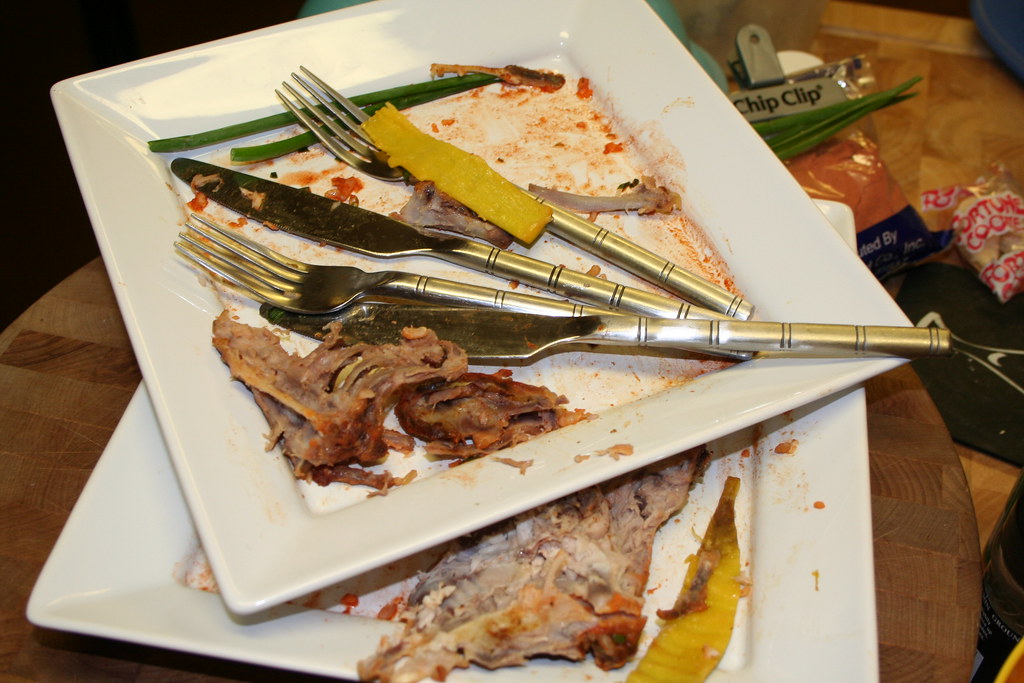
Season the chicken breasts with the cumin, paprika, salt, and pepper. Place them skin-side down in the pan. It should give a slow sizzle (if not, turn the heat down). The next step after this is the most important: don't f-ing touch the chicken breasts again until we're done. If you value crispy, browned, savory, delicate, heavenly chicken skin, then we're pretty much done here -- just let the heat do its thing. Brown the skin on the stove 4-5 minutes (okay, fine you can peek, but real quick), then transfer to the oven. Pop the smashed garlic cloves into the pan. Roast for about 30-35 minutes.
While you're doing absolutely everything you can to not disturb the chicken, cube/chop/mince the mangos/scallions/shallots/garlic and combine in a bowl. Add the li hing powder and mix. You might want to add the li hing a little at a time and taste it, because a little goes a long way.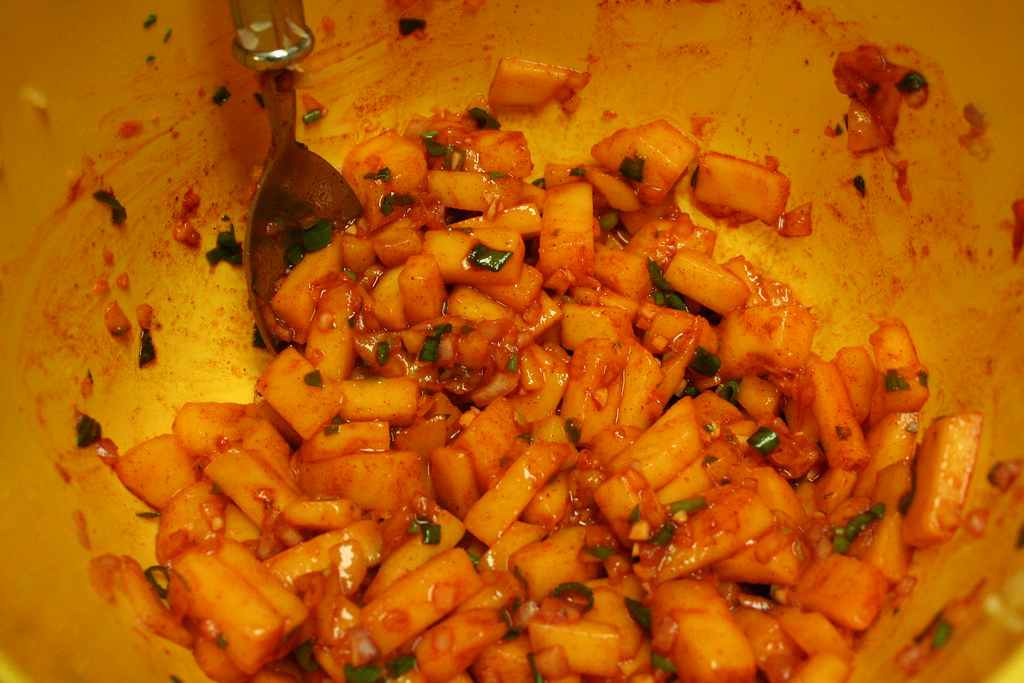
Maybe I'll be daring enough to actually put the li hing on the chicken directly next time. But until then... huzzah li hing!
25 March 2008
My Blueberry Nights
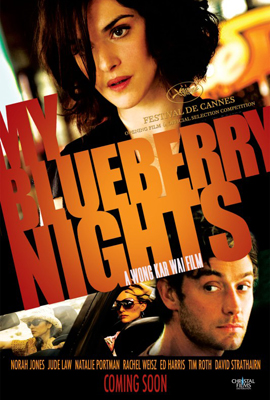
"I'll eat it," Elizabeth offers.
This is typically how things unfold in the world of Wong Kar Wai. His films are a triumph of atmosphere and tone over story. The plots meander and end up where they began, if they end anywhere at all. The characters ponder romantic heartache out loud, posit quirky theories, and often undertake curious, fruitless journeys on an emotional whim. Elizabeth has a series of after hours meals with Jeremy, who has a jar full of keys and the stories to match. He's an equally wounded soul who now only observes from behind his counter, refusing to act on his clear affections for Elizabeth. One night, Elizabeth decides to "take the longest way to cross the street" and heads first to Memphis, then Las Vegas, where she encounters a variety of hopeless romantics.
In her acting debut, Norah Jones has a sweet naturalness about her, but she's reduced to the role of observer for most of the running time, waitressing in various locales made all the more bustling and colorful by Wong's distinctly skewed photography. (WKW's #1 rule of cinematography: Get your characters just inside the edge of the frame. Then stop.) In Memphis she befriends Arnie (David Strathairn), an alcoholic who can't let go of his resentful ex-wife, Sue Lynne (Rachel Weisz). In Nevada, she stakes poker player Leslie (Natalie Portman) with her meager savings in exchange for a car.
Wong has a clear fascination with late night dining and ill-fated relationships, and food always takes on intriguing symbolic relationships with his characters. My Blueberry Nights, his first English-language film, is a kindred spirit with his Chungking Express and Fallen Angels. All revolve around greasy spoons and the strangers that inhabit them, passing each other in the night until the moment that they don't, their disparate paths suddenly crossing over. Chungking Express was a wonderful piece of romantic whimsy, but My Blueberry Nights misses the mark, trying to build emotional currents on a flimsy structure of contrived character sketches.
The film is a bit of an acting showcase as there's no shortage of crying, yelling, and other outpourings of emotion. What's missing is the quiet moments inbetween, the moments in which these characters actually make the decisions that lead to the building up or, mostly, breaking down of their relationships. Elizabeth narrates the meandering adventure in postcards written to Jeremy, but her observations don't contain much insight to either the situations or her point of view of them. Oddly, the most endearing moment for me was a throwaway scene when Jeremy, wanting simply to talk to his friend, calls every single diner in Memphis asking to talk to any waitress named Elizabeth.
There are a lot of nice moments in the story. I liked Sue Lynne coming to terms with Arnie by paying his insanely big bar tab, Elizabeth's mobile goodbye with Leslie when they separate at a fork in the highway, and Jeremy's musings on his jar of outcast keys. Unfortunately, the vignettes don't so much end as run out of steam, and Elizabeth's cross-country waitressing journey leads to a simplistic conclusion. My Blueberry Nights isn't more than the sum of its parts, forcing whimsy when there should be honesty. I wonder what would have been if Elizabeth had decided to take the short way across the street, instead.
Quick DVD note #1: You probably know to buy all region DVDs when purchasing on eBay (region code zero). Also remember to buy DVDs in NTSC format, as the PAL videos from Asia and elsewhere don't work in standard North American players.
Quick DVD note #2: An old XBox can play PAL! And if you have an HDMI cable for it, it can work as a poor man's upcoverting player, too. And to think, I was going to banish the thing to the garage. I heart you, old XBox.